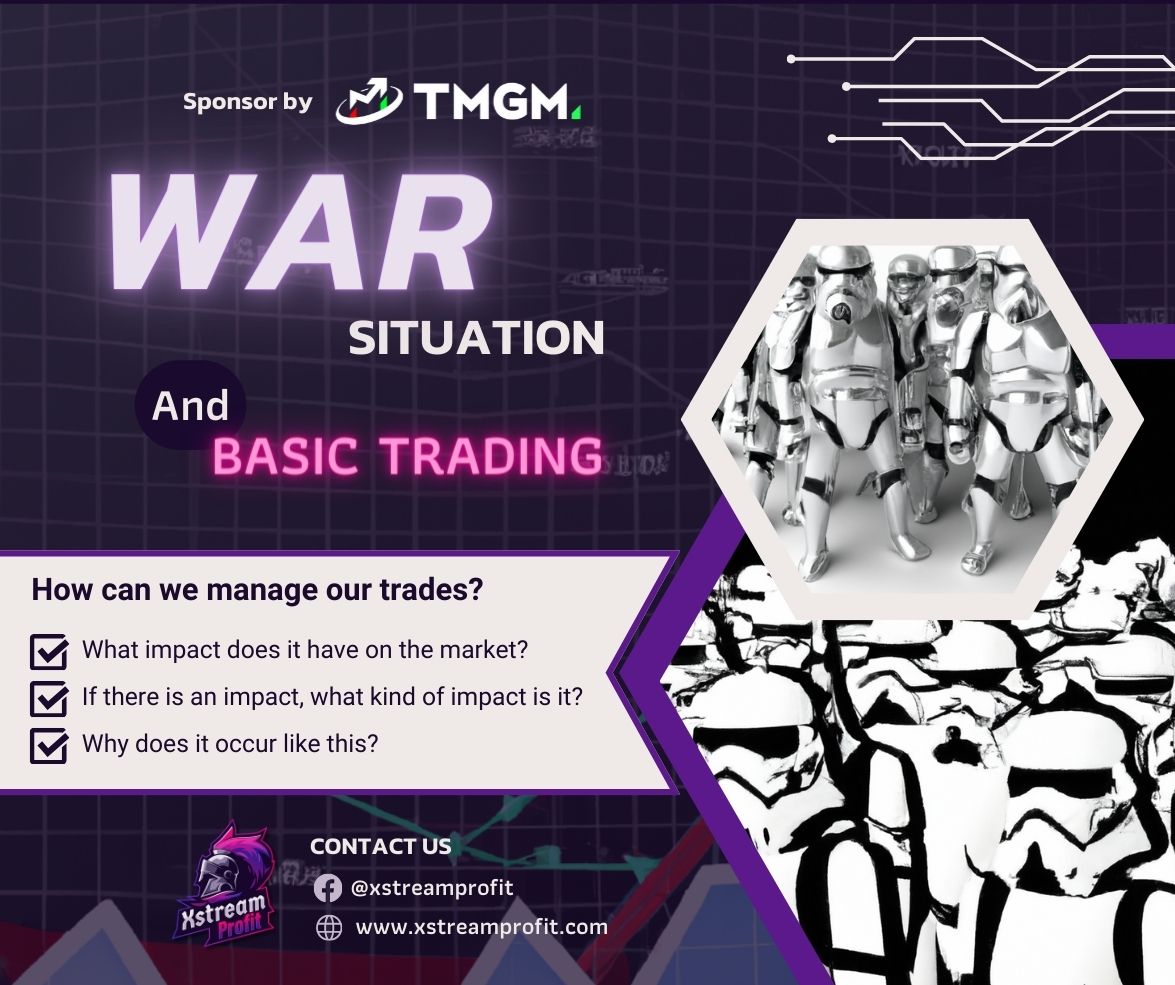
War and the Basic Circulation of Currency
“What’s going on with these graphs, why is it going up like this without stopping?”
“The dollar is strong, but why is gold going up? I’ve never encountered this in my trading.”
During this period, anyone who trades forex, futures markets, gold, or anything similar, even those who don’t trade, probably knows that there is news in the Middle East regarding the hostilities of the Hamas group in Israel, which has the potential to escalate into a major war.
What impact does it have on the market? If it does have an impact, what kind of impact is it? Why does it happen like this? How can we manage our trading in light of this knowledge?
Today, let’s talk about trading in a crisis situation
🌍 Supported by TMGM Broker
A world-class broker based in Australia
Open a self-traded gold rebate account with $10! Click here: https://bit.ly/3tAHKot
Chat for contact with TMGM & XP team, Click here: https://bit.ly/3rTLBwf
✅ Regulated by VFSC, ASIC, and FMA
✅ Fast deposits and withdrawals within 1 day
✅ Lowest spreads
✅ Whatever trading style you prefer, we have the tools ready
✅ Open an account for a 30% bonus credit
✅ Multilingual customer support available 24/7
*Investing involves risks. Investors should study information before making investment decisions.
Hello, meet with MT Admin, the old master.
Today is Monday, October 16, 2022. There is an interesting topic that we are going to discuss, which is “War Situation and Basic Trading”.
This topic will be an article about the basics of trading in a crisis situation.
As always, this is a very interesting topic. It is fundamental in the context of trading in a crisis market, something that many people may have never thought about before. Usually, the market never experiences a crisis, or if there is one, traders may not have encountered it before and therefore, may not pay much attention to it.
And when encountering a crisis market like this, interest gradually returns.
For example, why is the market running like this? Why is it only going up? Why is gold going up? Why is the dollar strong?
This article will provide basic knowledge of trading in a crisis situation so that you can have a clearer view.
If you read it, you will have a better understanding of trading in a crisis situation.
As always, this article is not related to trading techniques or trading psychology.
It is just knowledge and understanding of the basic market.
Let’s get started.
First, let’s familiarize ourselves with the term ‘crisis’.
In Thai, ‘crisis’ is translated as ‘ภาวะวิกฤติ’ which means a state of abnormality or deviation from the original state, resulting in the destruction, death, or disappearance of something, or a significant change.
A ‘critical point’, or ‘critical point’, is a point at which a situation transitions from a normal state to a crisis.
In a crisis situation, there are various types depending on what has caused the crisis. In the context of trading, there are several types of crises, such as:
- Financial Crisis
- Economic Crisis
- Stock Market Crash

These are specific names for different types of crises, each with its own set of causes. However, today we will specifically discuss the impact of war.
How does war have an impact that leads to a market crisis?
When an armed conflict, commonly known as war, occurs, soldiers engage in combat, resulting in casualties and military mobilization. This affects the civilian population in the area and related regions, making it difficult for them to work, trade, or even travel.
What happens is that the goods that were once readily available become scarce, and what was once affordable becomes unattainable.
Despite this, people’s demand remains the same, leading to a situation that appears as if there is excessive demand due to the reduced quantity of goods.
This gives rise to competition for purchases, hoarding, and price gouging, resulting in higher prices for goods. This means that the money that used to be able to purchase a certain quantity of goods now has reduced purchasing power.
When the prices of goods increase or the proportion of spending on goods rises, we refer to it as ‘inflation’. In another sense, it is known as ‘devaluation of currency’ or a decrease in purchasing power.
Additionally, there is a situation where people find it difficult to find jobs due to a lack of trading. This leads to money becoming scarce, and there is nothing left to buy.
This is what we call a crisis in times of war. The market undergoes significant changes from its usual state.
So, how do people with financial knowledge adapt in such a crisis?
The answer is they try to maintain their purchasing power.
Now, what exactly is purchasing power?
Purchasing power refers to the proportion of money used to buy a unit of goods. For example, in the past, a pack of instant noodles might have cost 2 baht, meaning the purchasing power for instant noodles was 0.5 packs for 1 baht.
Today, a pack of instant noodles might cost 6 baht, which means the purchasing power for instant noodles is now 0.18 packs for 1 baht.

This implies a decrease in purchasing power, or what we call inflation, where more money is required to buy the same quantity of goods.
In times of war, a similar scenario unfolds. Prices of goods rise significantly, leading to a decrease in purchasing power. The money one holds loses value, and they can buy fewer items.
Those in the know seek new ways to store their wealth. The requirement is that it must help maintain purchasing power, which brings us to gold.
Why gold, and not something else? The exact reason is unclear. It’s a phenomenon where, during a crisis, people tend to flock to it, much like why the right hand holds a spoon and the left holds a fork.
However, it’s undeniable that when this form of value exchange becomes prevalent, gold becomes a commodity that consistently rises in value during times of war. Those who understand this tend to choose to buy gold.
So, how does gold preserve purchasing power?
🌍 Supported by TMGM Broker
A world-class broker based in Australia
Open a self-traded gold rebate account with $10! Click here: https://bit.ly/3tAHKot
Chat for contact with TMGM & XP team, Click here: https://bit.ly/3rTLBwf
✅ Regulated by VFSC, ASIC, and FMA
✅ Fast deposits and withdrawals within 1 day
✅ Lowest spreads
✅ Whatever trading style you prefer, we have the tools ready
✅ Open an account for a 30% bonus credit
✅ Multilingual customer support available 24/7
*Investing involves risks. Investors should study information before making investment decisions.
Gold does so by serving as a medium of exchange. When people perceive it as valuable, there is competition to buy it, driving its price up. When some decide to sell their gold, they do so at a profit.
At the time of sale, the profit allows one to maintain their ability to purchase the same quantity of goods. This is why we say gold preserves purchasing power.
For example, let’s say there is 18,000 baht in the treasury. At one point, a pack of instant noodles costs 6 baht, and gold is priced at 18,000 baht per unit.
This means if one were to use the 18,000 baht to buy instant noodles, they’d get 3,000 packs. Later, during a war, if the price of instant noodles rises to 10 baht and gold to 30,000 baht, the same 18,000 baht would only buy 1,800 packs of instant noodles.
However, if one had purchased gold earlier, they’d have preserved their purchasing power. With 30,000 baht from selling the gold, they can still buy 3,000 packs of instant noodles.
This demonstrates that even though the price of gold has increased, those who bought it earlier can still purchase the same quantity of goods. This is why we say gold preserves purchasing power.
In reality, it doesn’t work exactly like this. When gold is exchanged back for money, the value is influenced by inflation. Nonetheless, it allows one to buy the same quantity of goods as before.
This is an example of how gold helps “preserve purchasing power.”
In summary, gold’s value rises with inflation. When people want to buy goods, they exchange gold for money, allowing them to maintain their purchasing power. This means you still have the same amount of money as before.
During a war, those with knowledge buy gold to “preserve purchasing power,” not for profit. When they’ve preserved their purchasing power, they sell the gold.
Even though the war continues, the price of gold can still fall because they bought gold to “preserve purchasing power.” When they’ve preserved their purchasing power, they sell the gold.
Therefore, be cautious. If the price of gold rises and hits a certain point, gold buyers may start selling, even if the war is still ongoing. This is because if they hold onto the gold, it means they haven’t regained their purchasing power. They must sell the gold for actual money first.
Another thing to consider is, apart from gold, what else can preserve purchasing power?
There are certain currencies in the world considered safe havens. I won’t go into the reasons behind this. These currencies include the US dollar and the Swiss franc (formerly the Japanese yen).
These currencies tend to see an influx of money because they are believed to preserve purchasing power. We can refer to assets or currencies that preserve purchasing power as “safe havens.”
In the context of war, “safe haven” refers to gold, the US dollar, and the Swiss franc. During wartime, money flows into safe havens, causing abnormal price movements.
Currency pairs like EURUSD and GBPUSD plummet, while gold rises. This can confuse those unfamiliar with the flow of money in times of war, wondering why the dollar is strong while gold is also rising.
However, after reading this article, you’ll understand that in times of war, money simply flows into safe havens. When the war eases, money flows back, creating a cycle.
That is the message I aim to convey in this article.
By the end of this article, at the very least, you’ll have a basic understanding of the flow of money in times of war or crisis due to war. You’ll understand what might occur, even if predicting the future, whether gold will rise or fall, is not possible. This understanding provides you with a foundational knowledge of trading, enabling you to trade at a more advanced level.
View trading as genuine buying and selling, not just playing with graphs to make money. “Because every price represents the tears of people in war.”
Thank you for reading to the end. Admin, MT 16-10-2023
This article is protected by intellectual property rights and reproduction for distribution by any party is strictly prohibited. The Admin will take legal action to the fullest extent.